

Overview
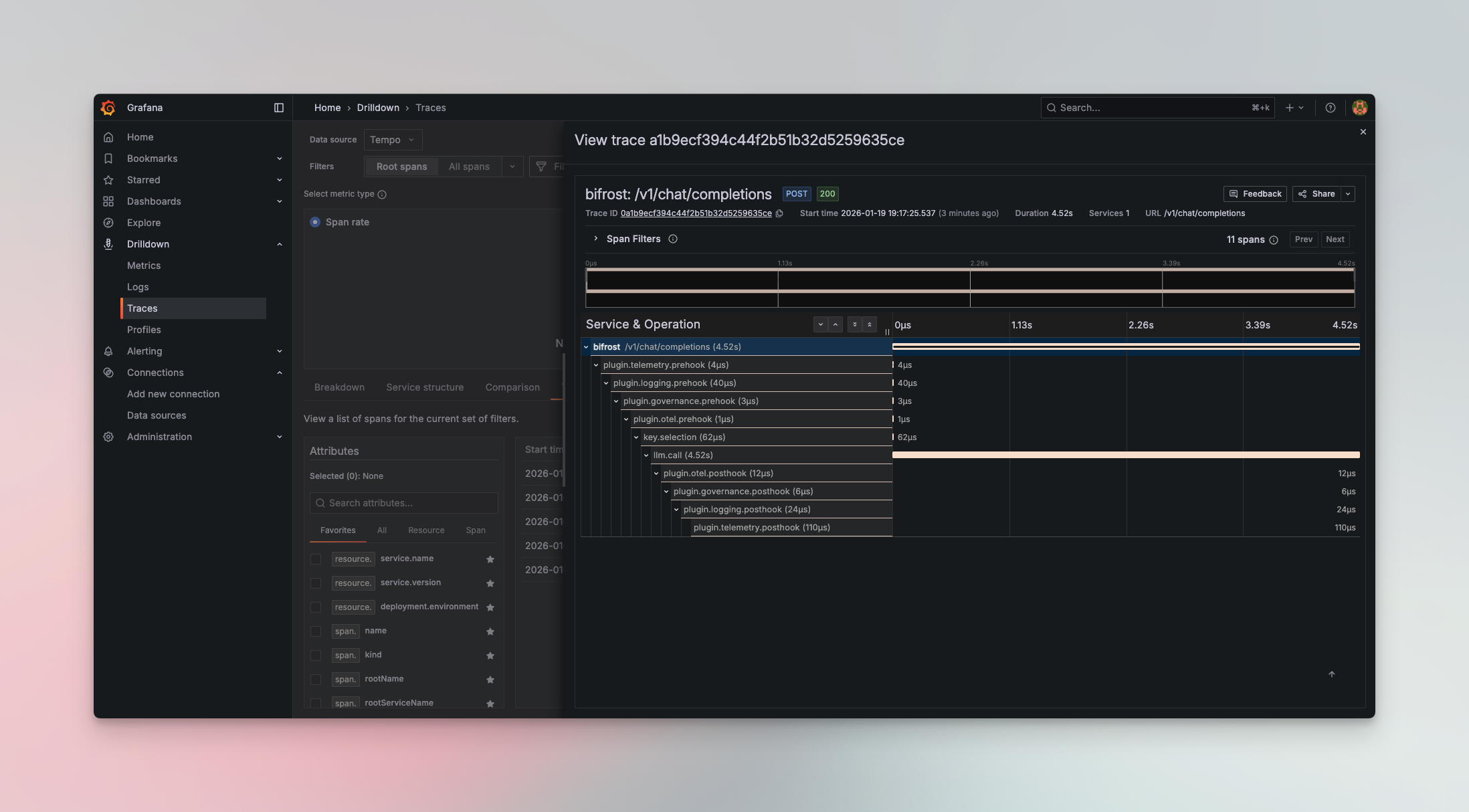
Supported Trace Formats
The plugin supports multiple trace formats to match your observability platform:Configuration
Required Fields
Environment Variable Substitution
collector_url, metrics_endpoint, and individual values in headers, trace_headers, and metrics_headers all support the env. prefix to read from environment variables at runtime. This keeps sensitive URLs and credentials out of stored configuration.
Per-signal headers
trace_headers and metrics_headers are available in Bifrost v2.0.0 and above.headers are sent to both the trace and metrics endpoints. When a collector needs a header on only one signal — for example a Databricks table name required on the metrics endpoint — use trace_headers or metrics_headers. Each is overlaid on top of headers for its own endpoint, and on a key collision the per-signal value wins.
Authorization, while the metrics endpoint receives both Authorization and x-databricks-zerobus-table-name. See the Databricks integration below for a full example.
Resource Attributes
The plugin supports the standardOTEL_RESOURCE_ATTRIBUTES environment variable. Any attributes defined in this variable will be automatically attached to every span emitted by the plugin.
- Environment identification - Distinguish between production, staging, and development traces
- Service versioning - Track which version of your service generated the trace
- Team attribution - Tag traces with team ownership for filtering and alerting
- Custom metadata - Add any key-value pairs relevant to your observability needs
Session Tracking
Whenever a request carries thex-bf-session-id header, Bifrost tags the trace’s root span with the OTEL-conventional session.id attribute. This happens regardless of the group_traces_by_session setting, so you can always filter and correlate traces by session in your backend even when each request remains its own trace.
Grouping Traces by Session
By default, each request Bifrost handles becomes its own OTEL trace (still tagged withsession.id as described above). Enable group_traces_by_session to instead group every request that carries the same x-bf-session-id header into a single trace, with each request’s root span appearing as a top-level sibling under that trace. This is useful for viewing a multi-turn conversation or agent run as one trace in your backend.
An inbound W3C
traceparent always takes precedence: a request that arrives on a distributed trace stays on that trace and is not regrouped by session. Session grouping only applies to requests that have a session ID but no incoming trace context.Because all requests in a session share one trace, very long-lived sessions produce large traces. Use a session scope that matches how you want to view activity in your backend.x-bf-session-id header on each request you want grouped together.
Coding-harness session header fallback is available in Bifrost v2.0.0 and above.
x-bf-session-id is absent, Bifrost adopts the harness’s own session header (Claude Code, Codex CLI, and OpenCode are recognized). That populates session.id on every request in the run; enable group_traces_by_session to collapse the run into a single trace. See Coding Harness Headers for the full list.
Setup
- UI
- Go SDK
- config.json
- config.json (v1.5.8+)
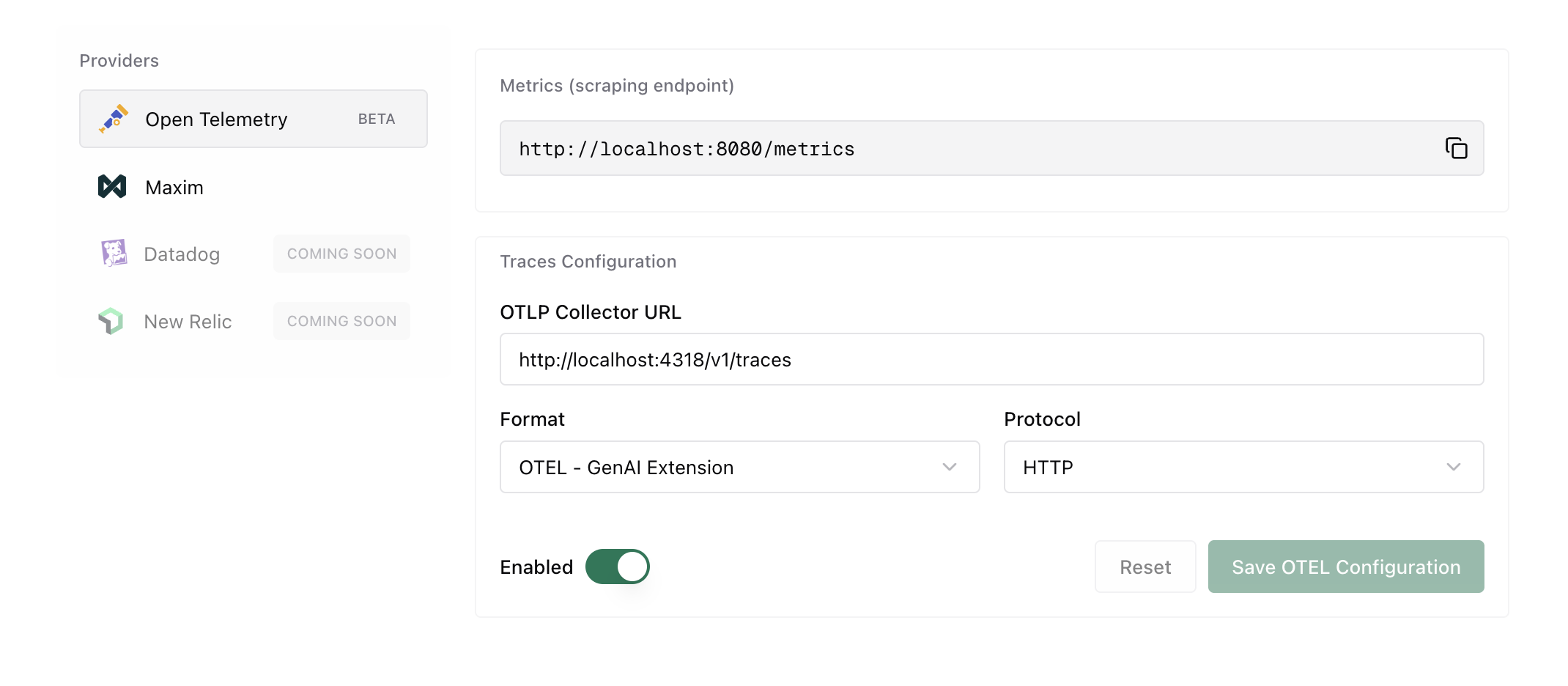
protocol: "http", the endpoint URL decides the transport: an https:// endpoint
is sent over TLS and an http:// endpoint over plain HTTP. insecure only controls
whether the collector’s certificate is verified, so leaving it at its default still
exports over TLS to an https:// endpoint. Set it to false to require a valid
certificate, optionally alongside tls_ca_cert for a private CA.
Quick Start with Docker
Get started quickly with a complete observability stack using the included Docker Compose configuration:- OTel Collector - Receives traces on ports 4317 (gRPC) and 4318 (HTTP)
- Tempo - Distributed tracing backend
- Prometheus - Metrics collection
- Grafana - Visualization dashboard
http://localhost:3000 (default credentials: admin/admin)
Popular Platform Integrations
- Grafana Cloud
- Datadog
- New Relic
- Honeycomb
- Langfuse
- Databricks
- Self-Hosted
Captured Data
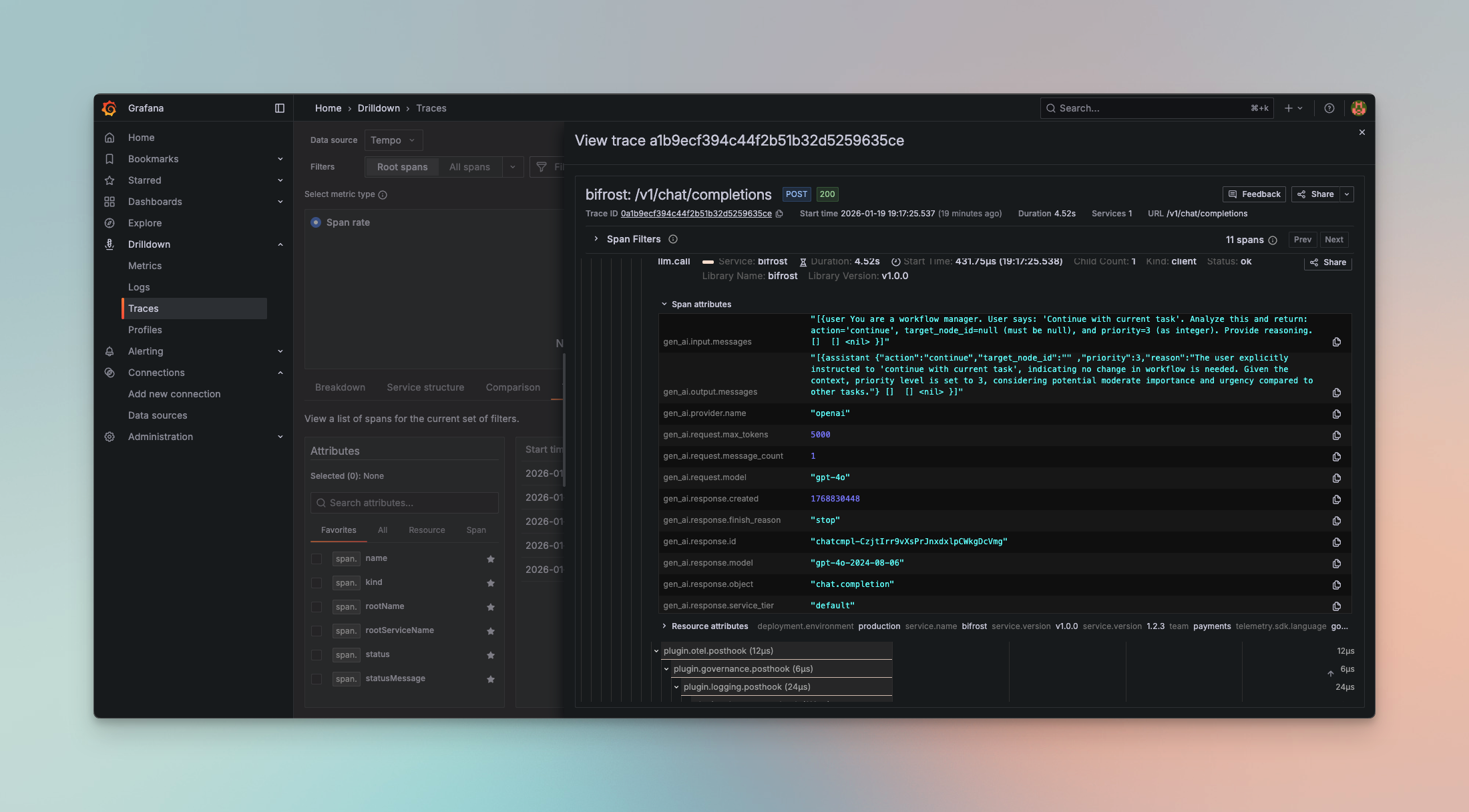
Each trace includes comprehensive LLM operation metadata following OpenTelemetry semantic conventions:Span Attributes
- Span Name: Based on request type (
gen_ai.chat,gen_ai.text,gen_ai.embedding, etc.) - Service Info:
service.name=bifrost,service.version - Provider & Model:
gen_ai.provider.name,gen_ai.request.model - Session:
session.idon the root span when the request carries anx-bf-session-idheader (see Session Tracking)
Request Parameters
- Temperature, max_tokens, top_p, stop sequences
- Presence/frequency penalties
- Tool configurations and parallel tool calls
- Custom parameters via
ExtraParams
Input/Output Data
- Complete chat history with role-based messages
- Prompt text for completions
- Response content with role attribution
- Tool calls and results
Controlling Exported Content
Two profile-level flags control how much message content leaves Bifrost:Excluding Attributes
Some span attributes are large and not needed downstream. Tool definitions are a common example. List the attribute names you want left out of exported spans:bifrost.raw_request or bifrost.raw_response keeps that body off exported spans while leaving the other one in place, which is finer-grained than turning export_raw_payloads off entirely.
Excluding an attribute controls what is exported, not what Bifrost collects. To stop provider-side raw-body capture, turn
store_raw_request_response off on the provider. To stop OTEL raw-payload assembly and export, disable export_raw_payloads on every profile.Raw Provider Payloads
export_raw_payloads attaches the raw bodies Bifrost exchanged with the provider to LLM spans, as bifrost.raw_request and bifrost.raw_response. This is what makes the provider’s wire format visible in Langfuse or any other OTLP backend.
- The provider must capture them —
store_raw_request_responseon the provider config. - This profile must opt in —
export_raw_payloads. Other profiles on the same collector are unaffected. disable_content_loggingmust befalse. It always wins: raw bodies are content.
Nothing is built unless a connector asks for it. With no profile setting
export_raw_payloads, the tracer never assembles raw bodies at all, so there is no cost to leaving it off.Performance Metrics
- Token usage (prompt, completion, total)
- Cost calculations in dollars
- Latency and timing (start/end timestamps)
- Error details with status codes
Use
bifrost.response.time_to_first_token_ms for latency dashboards and alerting that
should track what callers actually see. It is set on both the llm.call span and the
root span, so a trace-level dashboard can read it without drilling in.
Failed Requests
Failures are classified on the root span as well as thellm.call span, so a dashboard
built on root spans can distinguish causes rather than seeing only an HTTP status:
This also covers requests rejected before they reach a provider — no key supports the
requested model, a governance refusal, an unknown model. Those carry the requested model
and provider too, so they can be grouped the same way as provider-side failures.
Caller-Supplied Headers
Headers Bifrost forwards to the upstream provider — bothx-bf-eh-* prefixed headers and headers matched by the direct allowlist — are also surfaced on the llm.call span as gen_ai.request.extra_header.<name> attributes. This makes it easy to filter or correlate traces by caller context (session ID, tenant ID, correlation IDs) without standing up extra plumbing.
For example, sending x-bf-eh-session-id: sess-abc-123 produces the span attribute gen_ai.request.extra_header.session-id = "sess-abc-123". See Extra Headers for the full request format.
Example Span
Supported Request Types
The OTel plugin captures all Bifrost request types:- Chat Completion (streaming and non-streaming) →
gen_ai.chat - Text Completion (streaming and non-streaming) →
gen_ai.text - Embeddings →
gen_ai.embedding - Speech Generation (streaming and non-streaming) →
gen_ai.speech - Transcription (streaming and non-streaming) →
gen_ai.transcription - Responses API →
gen_ai.responses - MCP Tool Calls → MCP client spans with
mcp.method.name, plusgen_ai.tool.name,network.transport, and governance identity when available, anderror.typeon error spans
Protocol Support
HTTP (OTLP/HTTP)
Uses HTTP/1.1 or HTTP/2 with JSON or Protobuf encoding:gRPC (OTLP/gRPC)
Uses gRPC with Protobuf encoding for lower latency:Metrics Push (Cluster Mode)
Multi-node deployments: If you are running multiple Bifrost nodes, use push-based metrics for accurate aggregation. Pull-based
/metrics scraping may miss nodes behind a load balancer./metrics endpoint (which can miss nodes behind a load balancer), all nodes actively push metrics to a central OTEL Collector.
MCP client operations are exported as mcp.client.operation.duration (histogram, seconds) following the OTel MCP semantic conventions, dimensioned by mcp.method.name, gen_ai.tool.name, network.transport, error.type, and the governance dimensions virtual_key_id, virtual_key_name, team_id, team_name, customer_id, customer_name, business_unit_id, business_unit_name, project_id, project_name. This histogram covers all MCP client methods (tools/call, tools/list, ping, initialize) — to measure tool calls only, filter for mcp.method.name="tools/call".
Configuration
The collector is dialed lazily, so an unreachable metrics endpoint never blocks Bifrost startup or request handling. Metrics that fail to push are dropped and retried on the next interval.
Example Configuration
- HTTP Protocol
- HTTP Protocol (v1.5+)
- gRPC Protocol
- gRPC Protocol (v1.5+)
Metrics-only mode
To push metrics without exporting any traces, settraces_enabled: false on the profile. The trace client is then never built and collector_url is not required — only the metrics fields are. Traces and metrics are independent toggles, so a profile can export traces only, metrics only, or both.
Pushed Metrics
These are the same Prometheus-style metrics from the telemetry plugin, pushed via OTLP protocol to a central collector:Before Bifrost 2.2.2, a failure Bifrost raised itself — a request-conversion error, or an empty or unparseable provider response — carried no status of its own and was labelled
status_code="unknown", even though the caller received a 500. 5xx dashboards and alerts under-counted these. They are now labelled status_code="500", and the counter gained an error_type attribute matching the Prometheus one; repoint anything keyed on status_code="unknown". See Error Types for the error_type vocabulary.
Note: Size metrics are only recorded when the Content-Length header is present. Requests or responses without it (e.g., chunked transfer encoding, streaming responses) do not produce data points in these histograms.
Overhead breakdown
bifrost_overhead_component_microseconds decomposes the same overhead measured by bifrost_overhead_latency_microseconds into per-component histograms, sharing its bucket boundaries. It carries the same base attributes plus an overhead_component attribute naming the internal component, so summing every component for a given attribute set reconstructs the scalar total.
overhead_component takes one of a fixed set of ten values, each rolling the individual pipeline spans up into a category. These match the categories the Bifrost UI’s log-detail overhead breakdown groups into, so the metric and the UI agree:
The set is bounded, so the list above is exhaustive.
The metric is off by default. Enable it per profile with
overhead_breakdown_enabled (a sibling of metrics_enabled, under the profile’s Metrics section), or toggle Enable Overhead Breakdown on the Metrics tab of the Observability → OpenTelemetry page in the UI.
The breakdown is computed from completed trace spans, so it only populates when tracing/observability is active for the request. With tracing off,
bifrost_overhead_component_microseconds stays empty even when overhead_breakdown_enabled is on.OTEL Collector Configuration
Configure your OTEL Collector to receive OTLP metrics and export to your preferred backend (Datadog, Prometheus, etc.):Why Push vs Pull?
For single-node deployments, pull-based
/metrics scraping works well. For multi-node clusters, push-based metrics ensures all nodes are captured.
Advanced Features
Automatic Span Management
- Spans are tracked with a 20-minute TTL using an efficient sync.Map implementation
- Automatic cleanup prevents memory leaks for long-running processes
- Handles streaming requests with accumulator for chunked responses
Async Emission
All span emissions happen asynchronously in background goroutines:Streaming Support
The plugin accumulates streaming chunks and emits a single complete span when the stream finishes, providing accurate token counts and costs.Environment Variable Security
Sensitive URLs and credentials never need to appear in stored configuration. Thecollector_url, metrics_endpoint, and header values all accept the env.VAR_NAME format:
env.VAR_NAME reference from the process environment at runtime. Stored configuration (database or config file) retains the env.VAR_NAME string — the resolved value is never persisted. API responses return EnvVar objects with sensitive resolved values redacted.
Filtering Plugin Spans
By default every plugin’s pre- and post-hook execution generates a span, which can bloat traces when many plugins are active (e.g. 8 built-in plugins × 2 hooks = 16 plugin spans per request). Useplugin_span_filter inside the OTEL plugin config to control which plugin spans are exported.
Via config.json (inside the OTEL plugin config):
source_of_truth: "config.json" makes the file authoritative.
Filter modes:
Plugin names: list each plugin using the exact name shown for it in the Configure Plugin Tracing sheet — this is the same name that appears in the span (
plugin.<name>.<stage>), and it is what the filter matches against. The built-in OSS plugins are telemetry, prompts, logging, governance, otel, semantic_cache, compat, and maxim. In enterprise deployments some plugins are registered under a different name than their config key — for example the prompts and governance plugins appear as enterprise-prompts and enterprise-governance — so always copy the name from the tracing sheet rather than assuming the config key.
When a plugin span is filtered out, its children are automatically re-parented to the nearest exported ancestor so the trace hierarchy stays connected.
plugin_span_filter follows the standard plugin config precedence rules. To make a config.json value override UI-saved DB settings on restart, set source_of_truth: "config.json". See Source of Truth & Reconciliation for details.When to Use
OTel Plugin
Choose the OTel plugin when you:- Have existing OpenTelemetry infrastructure
- Need to correlate LLM traces with application traces
- Require compliance with enterprise observability standards
- Want vendor flexibility (switch backends without code changes)
- Need multi-service distributed tracing
vs. Built-in Observability
Use Built-in Observability for:- Local development and testing
- Simple self-hosted deployments
- No external dependencies
- Direct database access to logs
vs. Maxim Plugin
Use the Maxim Plugin for:- Advanced LLM evaluation and testing
- Prompt engineering and experimentation
- Team collaboration and governance
- Production monitoring with alerts
- Dataset management and curation
Agent Gateway
Agent Gateway operations are exported through the same OTel profiles as LLM and MCP calls. Each A2A operation becomes a client span withbifrost.a2a.operation.name, the agent name, status, timing, and available task and conversation IDs. Protocol methods also carry a2a.method.name; gateway-owned operations such as push_delivery use the Bifrost operation name. Streaming status and artifact updates appear as span events.
Structured request and response content uses gen_ai.input.messages and gen_ai.output.messages. Returned tasks, artifacts, and accumulated streaming output are represented in that content. Profile-level disable_content_logging, virtual-key content suppression, disable_root_span_content, and excluded_attributes apply to A2A exports too. Disabling content leaves operation metadata available.
Raw HTTP bodies require both Agent Gateway raw capture and the profile’s export_raw_payloads. Enabling capture alone does not export raw bodies. gRPC operations retain structured content but do not have raw HTTP capture.
When metrics are enabled, a2a.client.operation.duration records one duration in seconds per operation. Dimensions include bifrost.a2a.operation.name, the available method and upstream transport, governance attribution, and error.type on failures. Task, message, and session IDs are not metric dimensions.
See Agent Gateway observability for operation coverage and correlation.
Troubleshooting
Connection Issues
Verify collector is reachable:Missing Traces
Check Bifrost logs for emission errors:Authentication Failures
Verify environment variables are set:Next Steps
- Built-in Observability - Local logging for development
- Maxim Plugin - Advanced LLM evaluation and monitoring
- Telemetry - Prometheus metrics and dashboards