

Multi-Provider Setup
Configure multiple providers to seamlessly switch between them. This example shows how to configure OpenAI, Anthropic, and Mistral providers.- Using Web UI
- Using API
- Using config.json
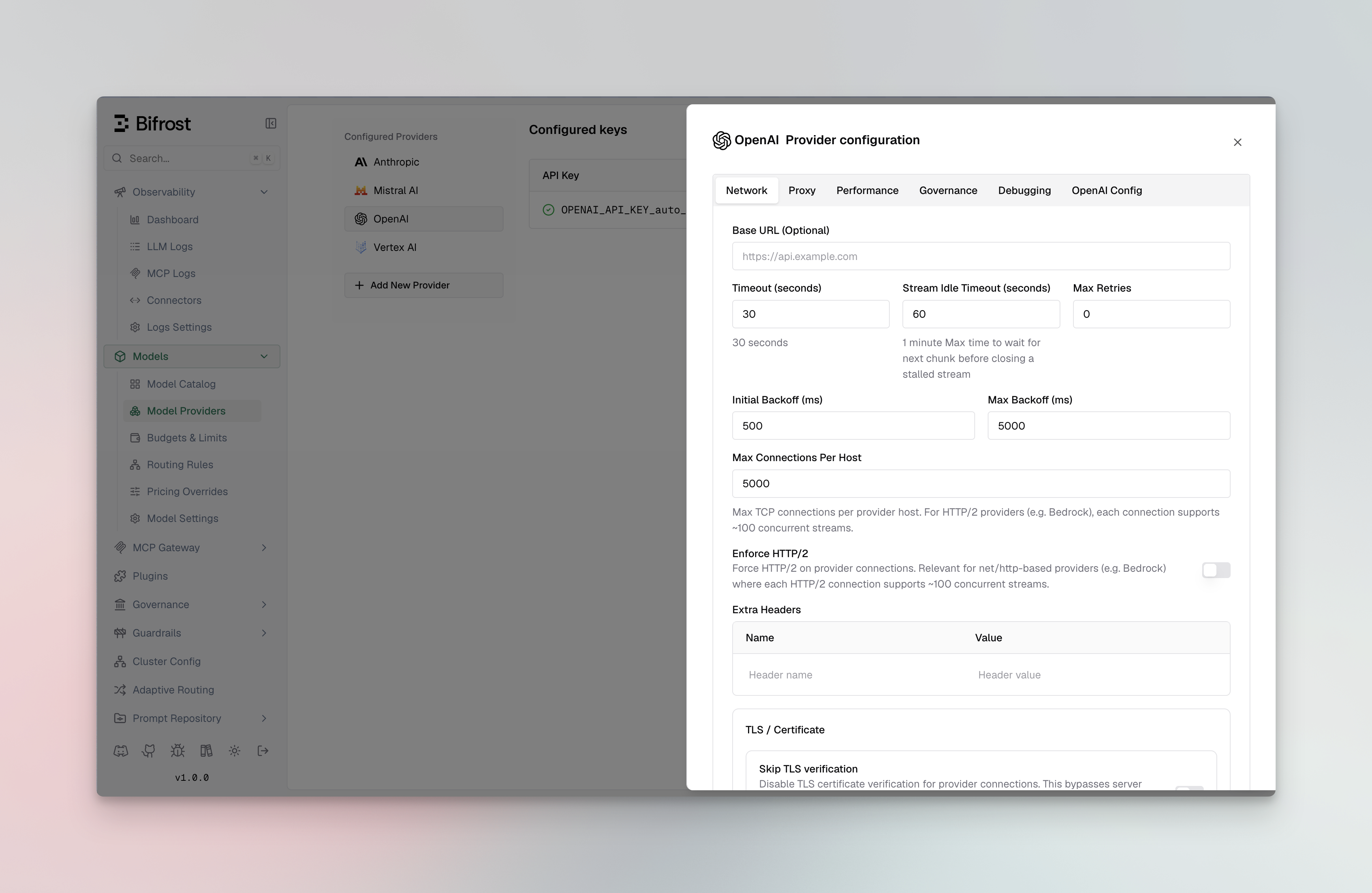
- Go to http://localhost:8080
- Navigate to “Model Providers” in the sidebar
- Select provider and configure keys
Making Requests
Once providers are configured, you can make requests to any specific provider. This example shows how to send a request directly to OpenAI’s GPT-4o Mini model. Bifrost handles the provider-specific API formatting automatically.Environment Variables
Set up your API keys for the providers you want to use. Bifrost supports both direct key values and environment variable references with theenv. prefix:
- Use
"value": "env.VARIABLE_NAME"to reference environment variables - Use
"value": "sk-proj-xxxxxxxxx"to pass keys directly - All sensitive data is automatically redacted in GET requests and UI responses for security
Advanced Configuration
Weighted Load Balancing
Distribute requests across multiple API keys or providers based on custom weights. This example shows how to split traffic 70/30 between two OpenAI keys, useful for managing rate limits or costs across different accounts.- Using Web UI
- Using API
- Using config.json
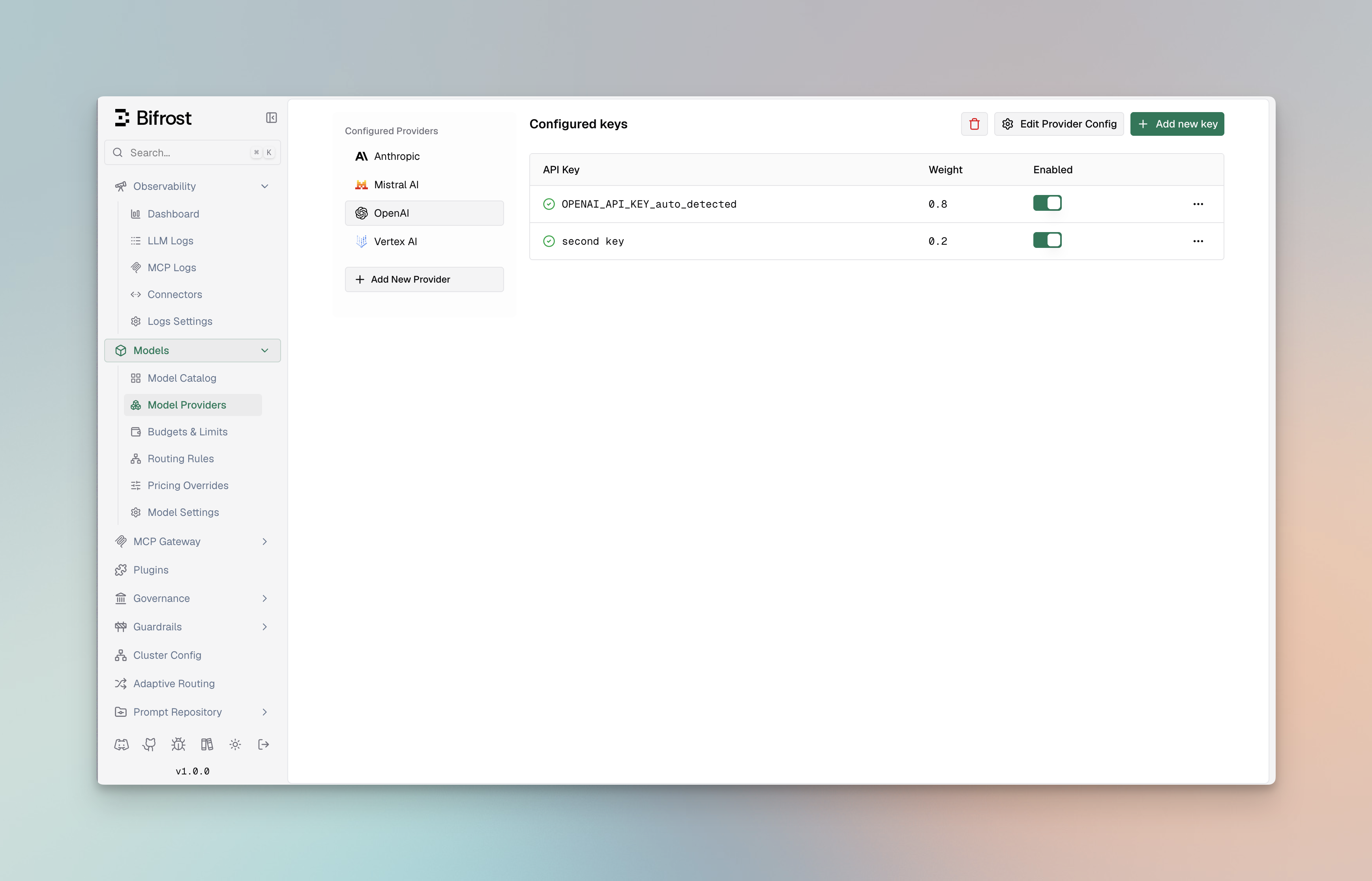
- Navigate to “Model Providers” → “Configurations” → “OpenAI”
- Click “Add Key” to add multiple keys
- Set weight values (0.7 and 0.3)
- Save configuration
Model-Specific Keys
Use different API keys for specific models, allowing you to manage access controls and billing separately. This example uses a premium key for advanced reasoning models (o1-preview, o1-mini) and a standard key for regular GPT models.- Using Web UI
- Using API
- Using config.json
- Navigate to “Model Providers” → “Configurations” → “OpenAI”
- Add first key with models:
["gpt-4o", "gpt-4o-mini"] - Add premium key with models:
["o1-preview", "o1-mini"] - Save configuration
Custom Base URL
Override the default API endpoint for a provider. This is useful for connecting to self-hosted models, local development servers, or OpenAI-compatible APIs like vLLM, Ollama, or LiteLLM.- Using Web UI
- Using API
- Using config.json
- Navigate to “Model Providers” → “Configurations” → “OpenAI” → “Provider level configuration” → “Network config”
- Set Base URL:
http://localhost:8000 - Save configuration
For self-hosted providers like Ollama and SGL,
base_url is required. For
standard providers, it’s optional and overrides the default endpoint.Private Network Access
If your provider runs on a private IP address (e.g. a local vLLM or Ollama instance on192.168.x.x or 10.x.x.x), set allow_private_network: true in network_config. Link-local addresses (169.254.x.x) remain blocked regardless of this setting.
- Using API
- Using config.json
Managing Retries
Configure retry behavior for handling temporary failures and rate limits. This example sets up exponential backoff with up to 5 retries, starting with 1ms delay and capping at 10 seconds - ideal for handling transient network issues.For a full explanation of how retries work, key rotation on rate limits, and
how retries connect with fallbacks, see Retries &
Fallbacks.
- Using Web UI
- Using API
- Using config.json
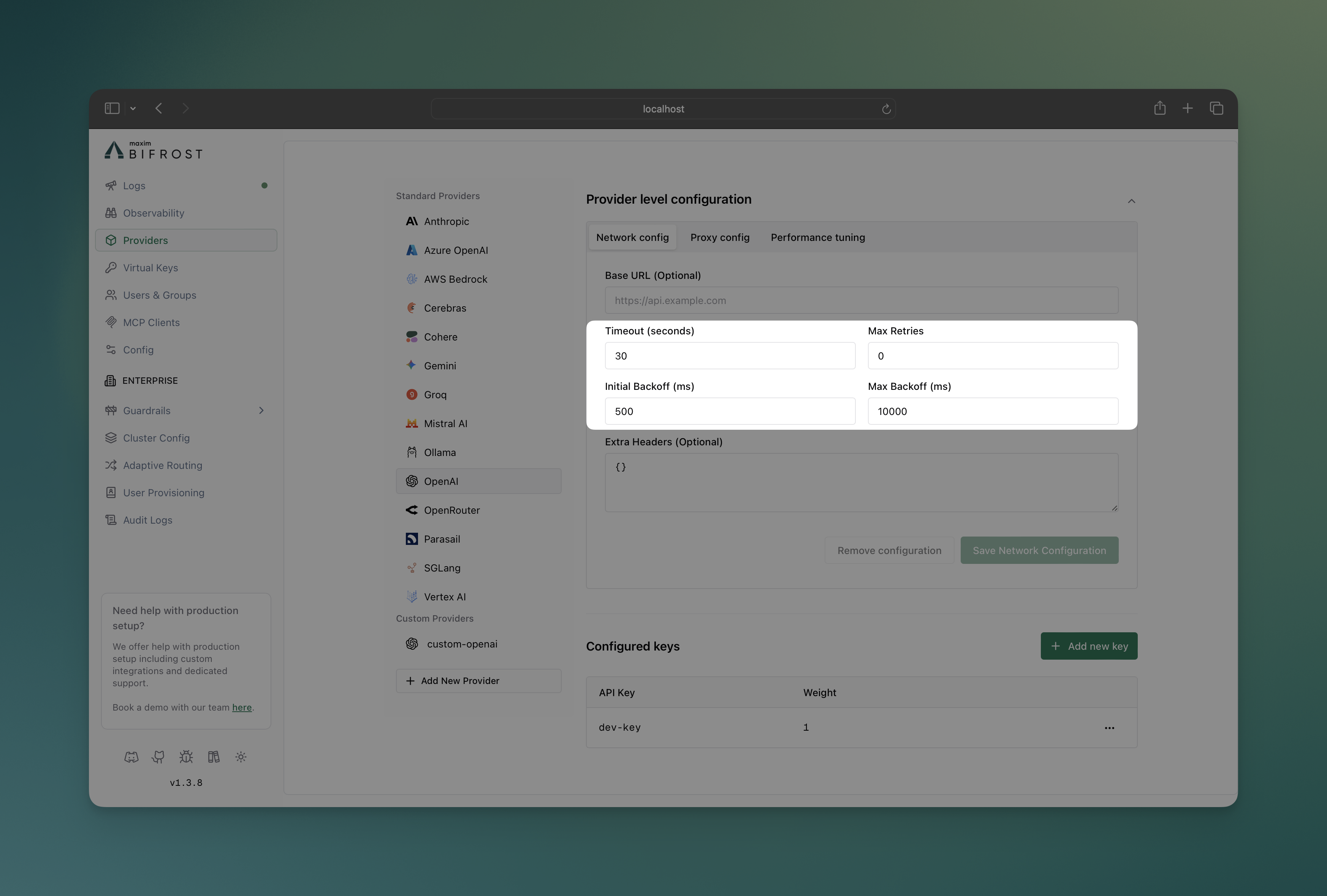
- Navigate to “Model Providers” → “Configurations” → “OpenAI” → “Provider level configuration” → “Network config”
- Set Max Retries:
5 - Set Initial Backoff:
1ms - Set Max Backoff:
10000ms - Save configuration
Custom Concurrency and Buffer Size
Fine-tune performance by adjusting worker concurrency and queue sizes per provider (defaults are 1000 workers and 5000 queue size). This example gives OpenAI higher limits (100 workers, 500 queue) for high throughput, while Anthropic gets conservative limits to respect their rate limits.- Using Web UI
- Using API
- Using config.json
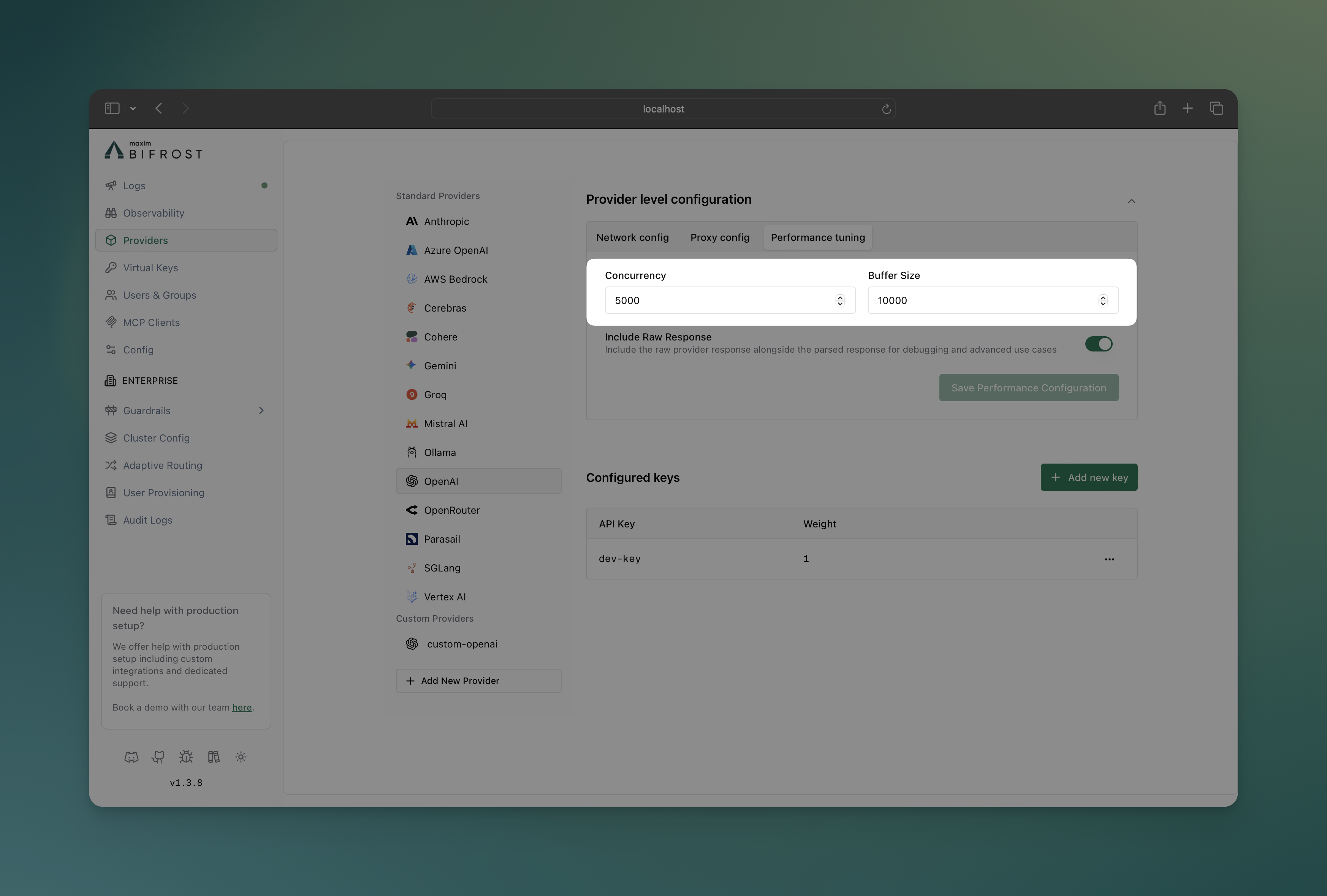
- Navigate to “Model Providers” → “Configurations” → → “Provider level configuration” → “Performance tuning”
- Set Concurrency: Worker count (100 for OpenAI, 25 for Anthropic)
- Set Buffer Size: Queue size (500 for OpenAI, 100 for Anthropic)
- Save configuration
Custom Headers
Bifrost supports two ways to add custom headers to provider requests: static headers configured at the provider level, and dynamic headers passed per-request.Static Headers (Provider Level)
Configure headers that are automatically included in every request to a specific provider. This is useful for provider-specific requirements, API versioning, or organizational metadata.- Using Web UI
- Using API
- Using config.json
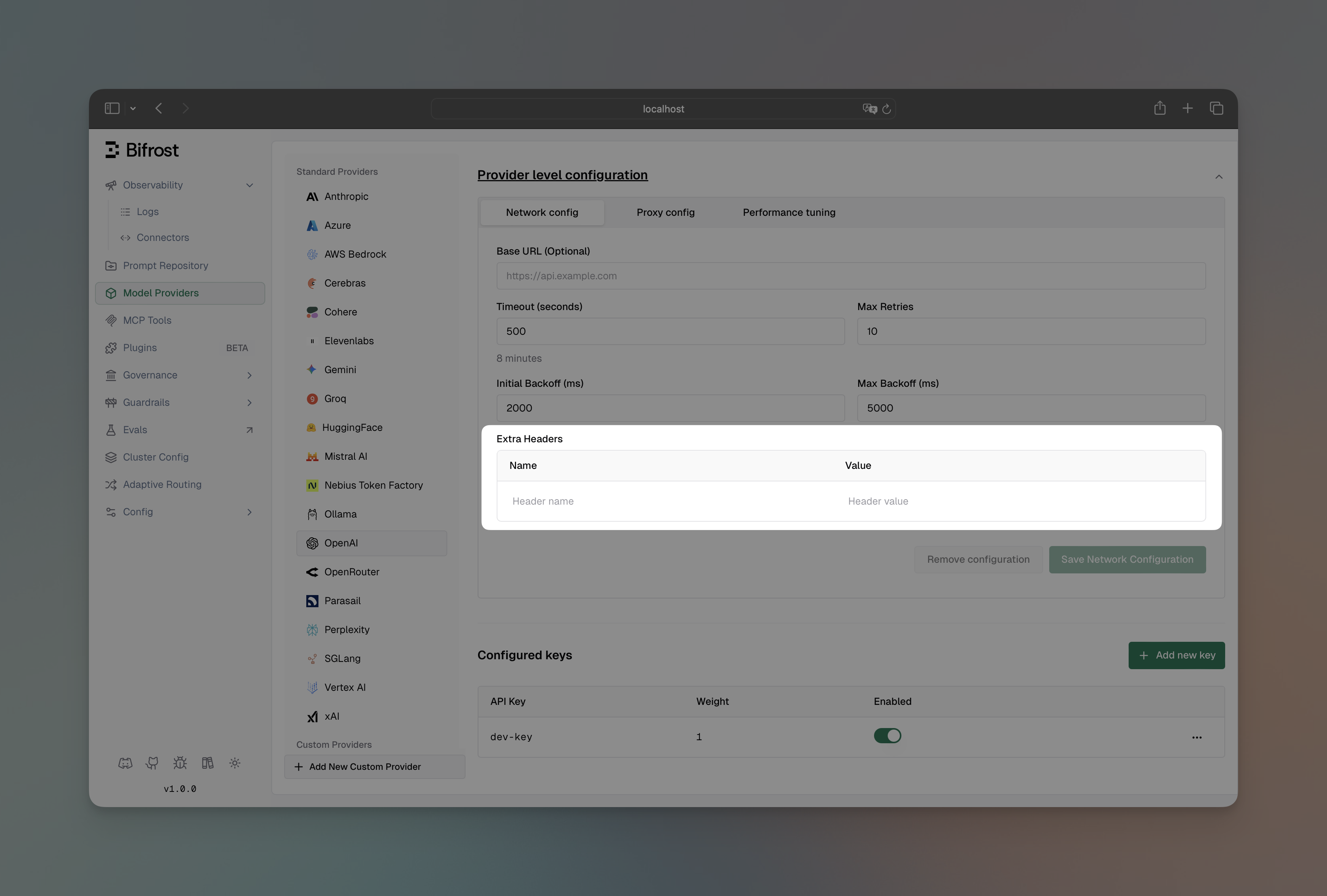
- Navigate to “Model Providers” → “Configurations” → “OpenAI” → “Provider level configuration” → “Network config”
- Add headers in the “Extra Headers” section
- Save configuration
Dynamic Headers (Per Request)
Send custom headers with individual requests using thex-bf-eh-* prefix. Headers are automatically propagated to the provider after stripping the prefix. This is useful for request-specific metadata, user identification, or custom tracking information.
x-bf-eh- prefix is stripped before forwarding, so x-bf-eh-user-id becomes user-id in the request to the provider.
Example use cases:
- User identification:
x-bf-eh-user-id,x-bf-eh-tenant-id - Request tracking:
x-bf-eh-correlation-id,x-bf-eh-trace-id - Custom metadata:
x-bf-eh-department,x-bf-eh-cost-center - A/B testing:
x-bf-eh-experiment-id,x-bf-eh-variant
Security Denylist
Bifrost maintains a security denylist of headers that are never forwarded to providers, regardless of configuration:Beta Header Overrides
For Anthropic-family providers (Anthropic, Vertex, Bedrock, Azure), Bifrost maintains a default support matrix foranthropic-beta headers. You can override these defaults per provider when upstream support changes before Bifrost updates its defaults.
TypeSafe and custom providers built on it have one entry, typesafe-danger-zone-images: the TypeSafe-Danger-Zone-Images header Bifrost adds to image and box requests, supported by default. See TypeSafe: Images and Box.
- Using Web UI
- Using API
- Using config.json
- Navigate to “Model Providers” → “Configurations” → select your provider → “Beta Headers” tab
- Each known beta header shows its default support status
- Use the override dropdown to set Enabled, Disabled, or Default (use built-in defaults)
- Save configuration
"redact-thinking-"), not full header values. This ensures overrides apply regardless of date-versioned header bumps. See the full support matrix in the Anthropic provider docs.
Setting Up a Proxy
Route requests through proxies for compliance, security, or geographic requirements. This example shows both HTTP proxy for OpenAI and authenticated SOCKS5 proxy for Anthropic, useful for corporate environments or regional access.- Using Web UI
- Using API
- Using config.json
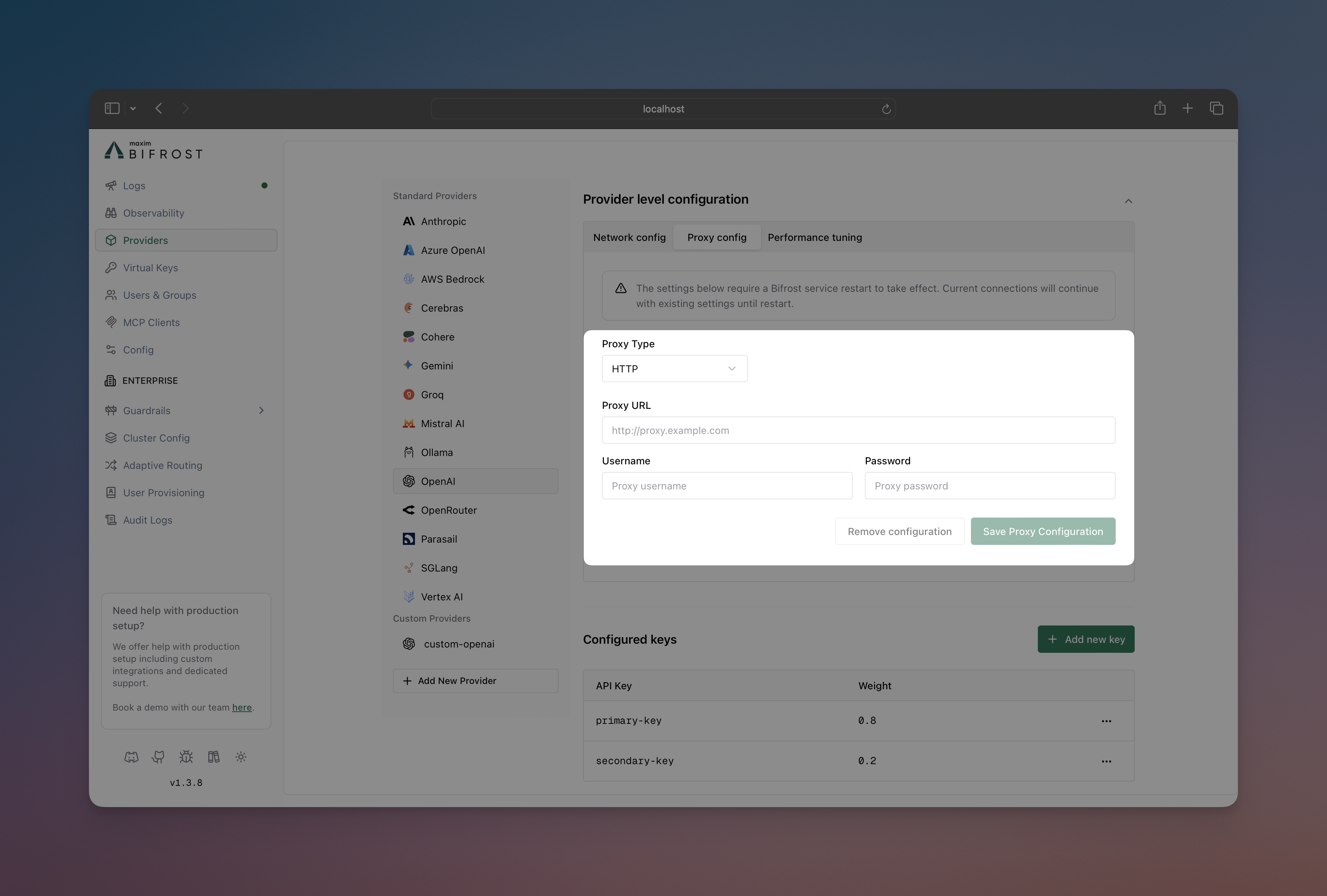
- Navigate to “Model Providers” → “Configurations” → → “Provider level configuration” → “Proxy config”
- Select Proxy Type: HTTP or SOCKS5
- Set Proxy URL:
http://localhost:8000 - Add credentials if needed (username/password)
- Save configuration
Send Back Raw Response
Include the original provider response alongside Bifrost’s standardized response format. Useful for debugging and accessing provider-specific metadata.You can override this per request using the
x-bf-send-back-raw-response
header ("true" or "false"), regardless of the provider-level config. See
Request Options for
details.- Using Web UI
- Using API
- Using config.json
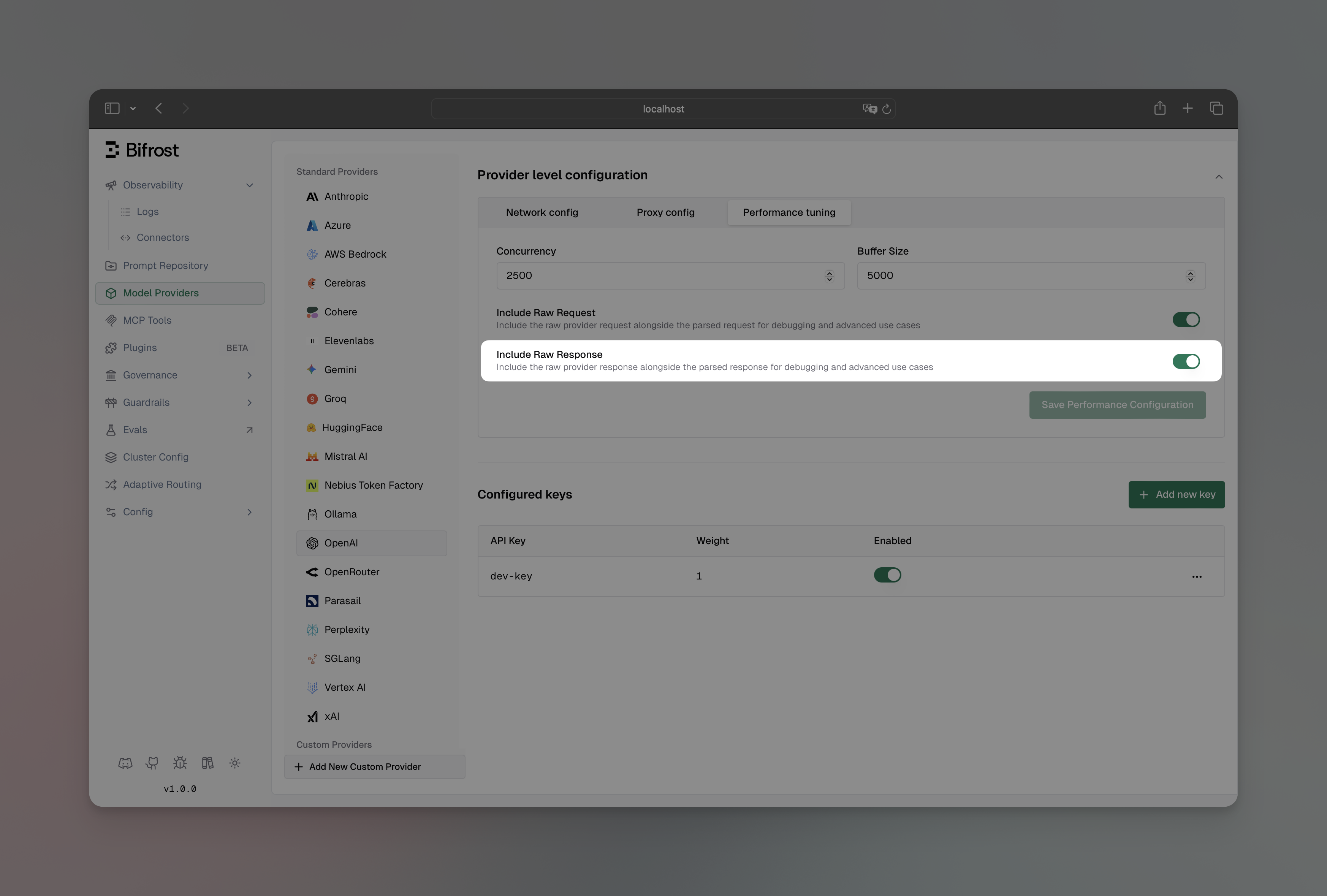
- Navigate to “Model Providers” → “Configurations” → → “Provider level configuration” → “Performance tuning”
- Toggle “Include Raw Response” to enabled
- Save configuration
extra_fields.raw_response:
Send Back Raw Request
Include the original request sent to the provider alongside Bifrost’s response. Useful for debugging request transformations and verifying what was actually sent to the provider.You can override this per request using the
x-bf-send-back-raw-request
header ("true" or "false"), regardless of the provider-level config. See
Request Options for
details.- Using Web UI
- Using API
- Using config.json
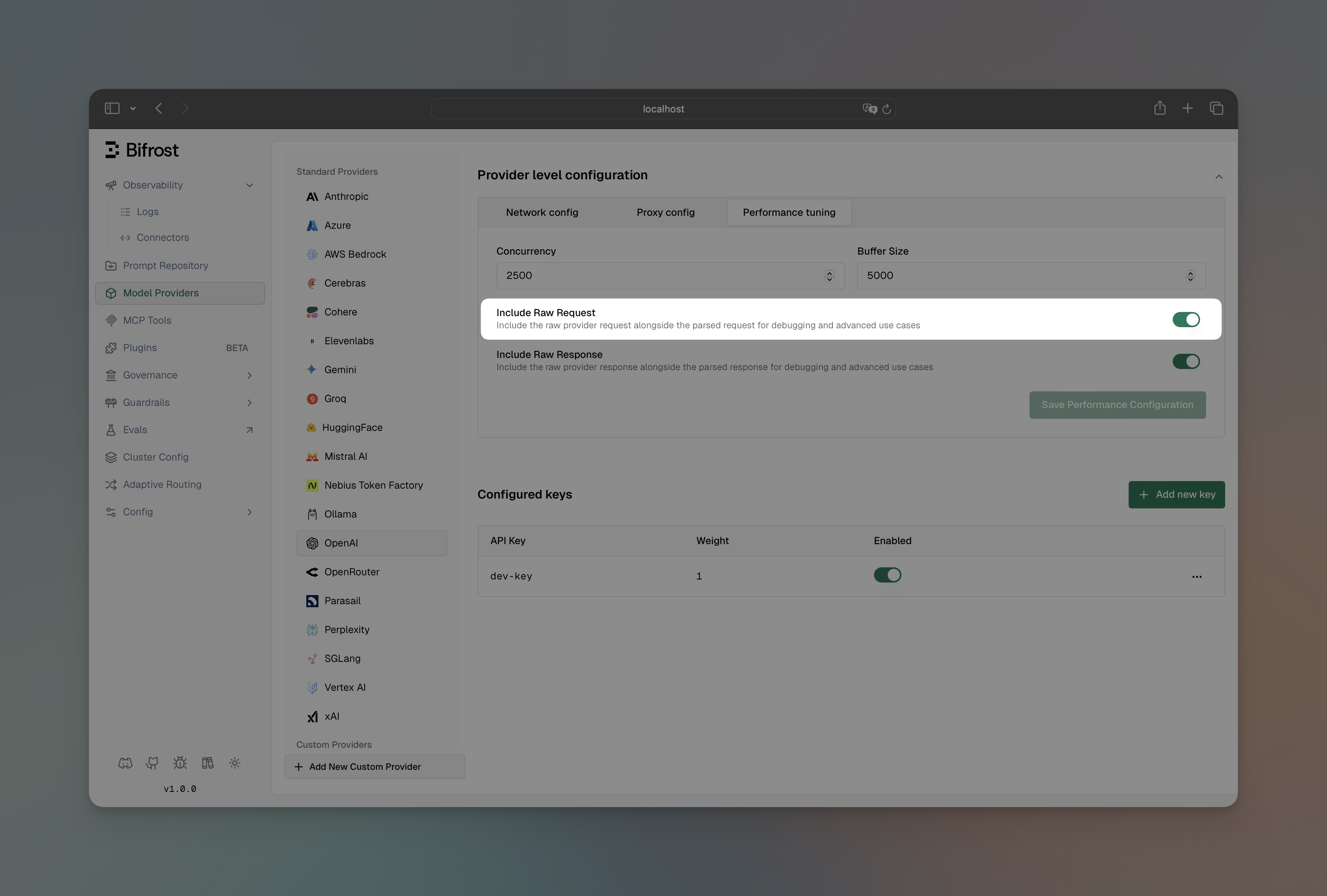
- Navigate to “Model Providers” → “Configurations” → → “Provider level configuration” → “Performance tuning”
- Toggle “Include Raw Request” to enabled
- Save configuration
extra_fields.raw_request:
Store Raw Request/Response
Persist the raw provider request and response in the log record. This is orthogonal tosend_back_raw_request and send_back_raw_response - enabling this does not affect whether raw data appears in the API response, and enabling send-back does not automatically store raw data in logs. Enable both to do both.
- Using Web UI
- Using API
- Using config.json
- Navigate to “Model Providers” → “Configurations” → → “Provider level configuration” → “Performance tuning”
- Toggle “Store Raw Request/Response” to enabled
- Save configuration
store_raw_request_response only has effect when the logging plugin is active - raw data is written to the log record by the logging plugin. Without it, enabling this flag captures the data but nothing persists it.You can override this per request using the x-bf-store-raw-request-response header ("true" or "false"), regardless of the provider-level config. See Request Options for details.Ignore provider-reported cost
Some OpenAI-compatible providers return their ownusage.cost in the response. When that figure is above zero, Bifrost uses it as the request cost and skips its own pricing, so pricing overrides have no effect for that provider. A reported cost of zero falls through to catalog pricing and overrides. The figure isn’t always USD. Cortecs, for example, reports credits, where 1 EUR is 1,000,000 credits, so a request that cost EUR 0.001067 shows up as $1067 in logs and budgets.
Turn on ignore_provider_cost to discard that value. Bifrost then prices the request from model pricing and any pricing overrides, and logs, budgets and telemetry use that cost. The response returned to your client still carries the provider’s usage.cost unchanged. If a model has neither catalog pricing nor an override, the model call itself gets no cost. A request can still log a cost and count toward budgets when it includes separately priced guardrail judge or routing-classification calls.
The Recalculate costs action in LLM Logs also honors this setting, so you can reprice requests that were logged before you turned it on.
- Using Web UI
- Using API
- Using config.json
- Navigate to “Model Providers” → “Configurations” → → “Provider level configuration” → “Pricing”
- Toggle “Ignore Provider-Reported Cost” on
- Save configuration
Passthrough Extra Parameters
Enable passthrough mode for extra parameters. When enabled, any parameters in theextra_params field (or provider-specific extra parameter fields) will be merged directly into the request sent to the provider, bypassing Bifrost’s parameter filtering.
- This feature only works for JSON requests, not multipart/form-data requests
- Parameters already handled by Bifrost (like
addWatermark,enhancePrompt) are not duplicated - they appear in their proper location - Nested parameters (e.g.,
parameters.custom_field) are merged recursively with existing nested structures - See Supported Headers for a complete list of all Bifrost headers
Next Steps
Now that you understand provider configuration, explore these related topics:Essential Topics
- Streaming Responses - Real-time response generation
- Tool Calling - Enable AI to use external functions
- Multimodal AI - Process images, audio, and text
- Integrations - Drop-in compatibility with existing SDKs
Advanced Topics
- Core Features - Advanced Bifrost capabilities
- Architecture - How Bifrost works internally
- Deployment - Production setup and scaling